AUTISM
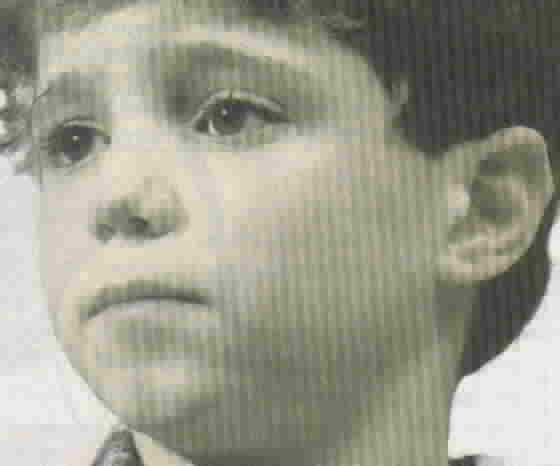
People talk to each other with their eyes, don't they? What are they saying? --Asperger's syndrome subject (quoted in Carter 1998:141)
Communications disorder. 1. A related family of conditions, from producing repetitive body
movements to showing a special gift for drawing, music, or math, marked by a lack of empathy
and an extreme inability to send and receive normal nonverbal cues. 2. An autistic person may fail to use socially normal patterns of eye contact, facial expressions, and gestures, and may be unable to use normal speech. 3. An autistic individual may
also display an intense interest in arranging, organizing, or hoarding a restricted range of physical objects.
Usage: When kept from handling a favored object, an autistic person may yell, become aggressive, or engage in property destruction. ". . . more than anything, autism is a defect of communication--an inability to share
feelings, beliefs and knowledge with other people" (Carter 1998:141).
Asperger's Syndrome. Like autism, AS includes problems in social behavior, along with abnormal responses to the environment. Unlike autism, however, cognitive and communicative skills may be relatively normal, and verbal skills are strong. AS individuals show an unusually restricted interest in specific artifacts, objects, or life forms, such as bus schedules, videotape cassettes, and frogs.
Behavior. "Their language skills are often limited, and they find it difficult to initiate or sustain conversations. They also frequently exhibit
an intense preoccupation with a single subject, activity or gesture" (Rodier 2000:56).
Embryology. In the first 20 to 24 days of gestation, a defect in the gene HOXA1 may be responsible a. for the physical appearance of the mouth, lower jaw, and ears, and
b. for the brain stem anomalies (see below, Neuro-note) of autism (Rodier 2000:59).
Physical appearance. 1. Autistic children produce few facial expressions, though they may exhibit
jaw-droop. 2. People with autism ". . . have often been described not only as normal in
appearance but as unusually attractive [perhaps due to a diminutive lower jaw and chin; see Facial Beauty]. They are certainly normal in stature, with normal-to-large
heads" (Rodier 2000:60). 3. "The corners of his mouth are low compared with the center of his
upper lip, and the top of his ears flop over [and are 'lower than normal' with 'an almost square
shape'] . . ." (Rodier 2000:59).
Psychiatry. "a) marked impairments in the use of multiple nonverbal behaviors such as eye-to-eye gaze, facial expression, body posture, and gestures to regulate social interaction" (diagnostic criteria for 299.00 AUTISTIC DISORDER, DSM IV).
Neuro-note. In an autistic person, the brain stem is shorter, the facial nucleus is smaller, and the
superior olive (an auditory relay station) may be missing entirely (Rodier 2000:58).
See also NONVERBAL LEARNING DISORDER.
Copyright © 1998 - 2001 (David B. Givens/Center for Nonverbal Studies)
Detail of photo by Justine Parsons (copyright 2000 by Scientific American)