EYEBROW-RAISE
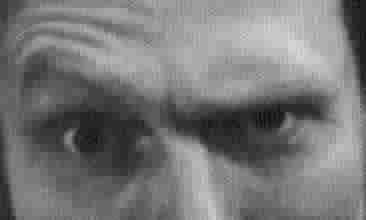
. . . the vast corrugated brow overhanging the proud eyes . . . . --Joseph Conrad (Lord Jim)
Facial expression. 1. To lift the arch of short hairs above the
eye, as in uncertainty, disbelief, surprise, or exasperation. 2.
To elevate the eyebrow by contracting the occipitofrontalis
muscle.
Usage I: Raising the eyebrows adds intensity to a facial
expression. Brow-raising can strengthen a dominant stare,
exaggerate a submissive pout, or boost the energy of a smile.
The involved muscle (occipitofrontalis) elevates the eyebrows to
form prominent, horizontal furrows in the forehead, making almost
any gesture look and feel stronger.
Usage II: In tandem with head-tilt-back, raising one or both
eyebrows suggests a supercilious air of disdain, haughtiness, or
pride. (N.B.: "Supercilious" comes from the Latin word for
"eyebrow," supercilium.) We may unconsciously lift our eyebrows as we
give orders, argue important speaking points, or make demands.
Anatomy. Our face evolved as a signboard to display emotions
welling from the mammalian brain. Facial messages are
controlled by the facial nerve (cranial VII). Its nucleus has
both an upper and a lower component; the former lifts
and depresses our eyebrows. When we feel happy, e.g., our limbic
brain stimulates cranial VII, which innervates
the forehead muscles to raise our brows.
Media. 1. "[Phil] Donahue has a characteristic way of raising his eyebrows which draws attention to his eyes which are directed to the [TV] viewers" (Raffler-Engel 1984:12). 2. To convey authority and show strong emotion,
televangelists raise their eyebrows and project their foreheads'
horizontal lines onto the video screen for added dramatic effect.
RESEARCH REPORTS: 1. Eyebrow-raise is a threat sign in baboons,
mandrills, and cebus monkeys (Andrew 1965; van Hooff 1967). 2.
The eyebrow-flash of recognition is a worldwide friendly greeting
(Eibl-Eibesfeldt 1989; Morris 1994). 3. One eyebrow raised (as in
the eyebrow cock) is a widespread sign of scepticism (Morris
1994).
Neuro-notes. Brow-raising is mediated by the top part of cranial VII's motor nucleus, which contains
cells to innervate the contraction of muscles in the upper part of
our face. The top part receives bilateral input from both sides
of the cerebral neocortex, rather than unilaterally (as in the bottom part of
the nucleus, which controls the muscles of the lower half of our
face).
See also EYEBROW-LOWER.
Copyright 1999, 2000 (David B. Givens/Center for Nonverbal Studies)
Detail of photo copyright by Linda McCartney.