INVISIBILITY
Come, my son, let us go look for a place where I may hide . . . . --Cervantes (Don Quixote, 1605:565)
Keeping reflections to a minimum is necessary but not sufficient for invisibility. Light must also
pass unimpeded through the body . . . . --Sönke Johnsen (2000:88)
Not seen. Nonverbally, the condition of being difficult or impossible to see, as in the use of
camouflage, concealment, flatness, thinness, hiding, or transparency.
Usage: Animals from jellyfish to humans have devised ingenious ways to be stealthy and to
avoid detection.
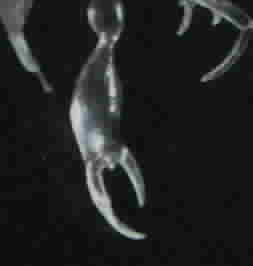
Jellyfish. In the featureless ocean depths which make up ca. 99 percent of Earth's living space,
jellyfish have no place to hide, and thus rely upon transparency to become "invisible." Their clear,
gelatinous bodies (the interior as well as the exterior surfaces) allow from 20 to 90
percent of light to pass through, thus enabling these simple creatures to sneak up on prey while
avoiding detection by sighted enemies (Johnsen 2000:88).
Human beings. 1. In the corporate world, humans may become functionally invisible by
keeping a low profile (e.g., by remaining silent), and by covering their bodily exteriors with the
uniform of the day (see, e.g., BUSINESS SUIT, ISOPRAXISM). 2. In private life, human beings spend a great deal of time in seclusion behind closed doors (e.g., in bathrooms and bedrooms) and other partitions designed to shield their bodies from prying eyes. Scientists have determined that too much visual monitoring can be harmful to human health.
Hunter's camouflage. According to Konrad Spindler (1994:147), the 5,000-year-old grass cloak of the Copper Age Iceman would have provided "excellent camouflage" for a hunter.
Sighting distance. "At some distance, depending on the animal's original contrast and how the
water affects the light, the contrast drops below what the observer can see. This distance is
known as the sighting distance, and beyond it the animal is invisible (and safe)" (Johnsen
2000:87).
Underground. "Throughout history, tunnels hidden below the earth were far from public gaze and thought" (Langrall 1994:4).
Copyright 2000 (David B. Givens/Center for Nonverbal Studies)
Detail of photo (copyright by Harbor Branch Oceanographic Institution)