A stew with more beef than mutton in it, chopped meat for his evening meal, scraps for a Saturday, lentils on Friday, and a young pigeon as a special delicacy for Sunday . . . --Miguel de Cervantes (Don Quixote; 1605:25)
It's a fun product. When I meet someone at a party and tell them where I work, they smile. People love hot dogs. --Bob Schwartz, VP of Sales, Vienna Beef in Chicago (Jackson 1999:106; see below, Hot dogs)
Flavor cue. 1. The usually pleasant aroma and taste of cooked animal flesh (i.e., muscles and
skin). 2. Intensely flavorful molecules created a. as myoglobin, the red pigment of raw steak,
turns brown and a flavor-rich coating forms (as juices evaporate from the meat's surface), and b.
as the browning reaction releases furans, pyrones, and other carbon, hydrogen, and oxygen
molecules which provide the complex oniony, nutty, fruity, chocolate, and caramel-like tastes we
prefer to the bland taste of uncooked meat and raw vegetables (McGee 1990).
Usage I: The aroma of sizzling beefsteak basted with sage and garlic sauce is an irresistible chemical signal transmitted when a chef brushes the meat with seasonings and sears it with flame. According to McGee, "All cooked foods aspire to the [rich and flavorful] condition of fruit" (1990:304).
Usage II: In Nonverbal World, the essence of charbroiled steak evokes an
emotional desire to approach the aroma. Among the most evocative of all chemical signals
processed by the brain are those emanating from meats and meaty consumer products,
such as the Big Mac® sandwich and fried Spam®.
Evolution I. As did late-Devonian amphibians, early mammals of the Cretaceous and early primates
of the Paleocene epoch passed through a predominantly flesh-eating stage. Acting in accordance
with a primeval chemical code, amphibians pursued fish (and fellow amphibians), while mammals
and primates pursued mainly insects. With so many carnivores and insectivores on the
family tree, we respond to meats with an extreme alertness, as if scripted to do so by the ancient
code.
Evolution II. "Scientists
theorize that the shift to hunting and meat eating was a key adaptation that
let our ancestors spread beyond Africa and led to the dramatic increase in
brain size associated with our human lineage. This 'dietary revolution,' as one paleontologist put it, could have changed
the human facial structure by reducing the size of the molars, which
previously needed to be large to chew tubers and raw vegetables. As the
protruding jaw began to recede, more of the skull could be used to house the
brain. And a diet of fat-rich bone marrow could lead to the development of the
brain cells" (McCafferty 1999:22).
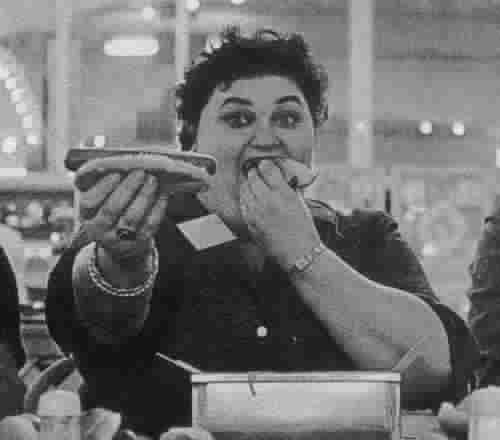
Hot dogs. 1. An estimated 20 billion hot dogs are consumed in the U.S. each year (Jackson 1999:110). 2. "But the hands-down wiener and still champion of frankfurter flackery is the annual Fourth of July hot-dog eating contest at Coney Island . . ." (Jackson 1999:110; as of June 1999, the record was 19 dogs consumed in 12 minutes [Jackson 1999:112]).
Kebabs. "A huge kebab made with 1,500 chickens was cooked at this tourist resort [in Limassol, Cyprus] Sunday [June 10, 2001] in a bid to make the Guinness Book of Records" (Anonymous 2001:A3).
Media. According to Scientific American magazine, in 1999 the per capita U.S. consumption of beef was 64.7 pounds (chicken = 49.2, pork = 48.8; Anonymous 2000D).
Prehistory I. Two m.y.a. our first human ancestor, Homo habilis, wandered east Africa's arid savannah grasslands in search of ripe fruit, nuts, tubers, and berries--and small game, bird eggs, insects, and edible grubs. It is likely that Homo's original "hunting instinct" involved the corticomedial division of the amygdala, which plays a role in mammalian hunting psychology today (Carlson 1986:486).
Prehistory II. On the savannah, meat made up 20-to-30 percent of the early human diet, as it did
that of historical hunter-gatherers such as the !Kung San Bushmen of Botswana.
Prehistory III. So appealing is the taste of cooked meat that ". . . after early humans migrated into Australia and the Americas, the heavyweight animals of these new continents were driven to extinction within a few thousand years" (Anonymous 2001F:A1), according to reports in Science (June 2001). Mammoths, camels, mastodons, and the glyptodont, as well as giant sloths, snakes, lizards, birds and marsupials, were hunted, cooked, and eaten to extinction, according to the now more widely accepted "blitzkrieg model" of anthropologists.
RESEARCH REPORT: A craving known as meat hunger is a "widespread phenomenon among
peoples living at a subsistence level [i.e., who are not vegetarians by choice]"
(Simoons 1994:6). (N.B.: In the U.S., despite well-stocked produce displays, shoppers spend the
largest portion of their supermarket dollar on beef, chicken, fish, and pork.)
Neuro-notes. 1. We crave meaty taste because the amphibian brain's hunger for flesh is
older than the primate brain's "acquired taste" for fruits and nuts. 2. As it influenced
the pursuit, handling, and killing of game, the amygdala also stimulated the release of digestive juices in
preparation for eating the kill. Thus, today, hidden aggressiveness in the meat-eater's code makes a
sizzling steak more exciting than a bowl of fruit. This explains, in part, why (when possible and affordable)
meals throughout the world are planned around a meat dish.
See also GLUTAMATE, HERBS & SPICES, SHELLFISH TASTE.
Copyright © 1998 - 2001 (David B. Givens/Center for Nonverbal Studies)