NICOTINE
With men in the Army, the Navy, the Marine Corps, and the Coast Guard, the favorite cigarette is Camel. (Based on actual sales records.)--Camel advertisement on back cover page of Life magazine (July 10, 1944)
Afferent cue. 1. A potent alkaloid drug (C10H14N2) of the tobacco plant, ingested by hundreds of
millions of men, women, and children in consumer products such as cigars, cigarettes, and snuff.
2. The most addictive chemical substance ever used by Homo sapiens.
Usage I: Nicotine "speaks" directly to the brain as an incoming nonverbal cue. Currently, there is a worldwide epidemic of nicotine use.
Usage II: According to a 1999 World Health Organization estimate, there are four million deaths a year from tobacco. Based on present smoking trends, tobacco is predicted to be the leading cause of disease in the world, causing ca. one in eight deaths.
Usage III: 1. Nine out of 10 human beings who smoke a cigarette for the first time become addicted, according to statistics of the U.S. National Institutes on Drug Administration. 2. According to a trade publication, Tobacco Reporter, the average American cigarette smoker buys ten packs of 20 cigarettes per week. 3. Worldwide, a third of all adults (36%) smoke cigarettes--and are hopelessly addicted to nicotine.
Usage IV. According to a March, 2001 study published in Preventive Medicine (Vol. 32, pp. 262-67), the use of smokeless (i.e., chewing) tobacco is a predictor of later cigarette-smoking initiation in young U.S. adult males.
Evolution. Nicotine evolved as a communicative sign, i.e., as an insect-repelling secondary product.
Early history. 1492: "Almost from the day of first landfall, on October 12, 1492, the inhabitants of Guanahani (San Salvador, Bahamas) regaled the newcomers with such herbs [i.e., tobacco plants]. And upon encountering near Fernandia Island a man in a small canoe carrying the same plant material among his meager essentials, Christopher Columbus surmised that the Indians held the leaves in high esteem" (Wilbert 1987:9).
Later history. 1797: Cigarettes appear when Cuban cigar makers roll little cigars in paper wrappers (Trager 1992:354). 1883: Gold Flake cigarettes appear in London (Trager 1992:567). 1885: Thomas Edison, a tobacco chewer, refuses to hire tobacco smokers (Trager 1992:585). 1925: Old Gold cigarettes appear, with the slogan, "Not a cough in a carload" (Trager 1992:773). 1955: U.S. cigarette consumption increases as media ads promote filter-tipped Winstons, king-size Tareytons with "activated charcoal" filters, and Marlboro filters (Trager 1992:953).
Media. In the U.S. the advertising of cigarettes on television was banned in 1971, "abruptly
removing one of the major categories of broadcast income" (Jankowski and Fuchs 1995:106).
Neuro-notes. 1. Nicotine ". . . mimics the neurotransmitter acetylcholine by acting at the
acetylcholine site and stimulating the nerve cell dendrite" (Restak 1995:116). Nicotine leads to
the release of pleasure-enhancing dopamine and morphine-like endorphins. 2. "In both mice and humans, they [Joseph R. DiFranza, University of Massachusetts Medical School in Worcester, and others] say, the number of high-affinity nicotinic cholinergic receptors has been seen to increase in the brain after only the second dose of nicotine" (Cooke 2000).
Copyright© 1998 - 2001 (David B. Givens/Center for Nonverbal Studies)
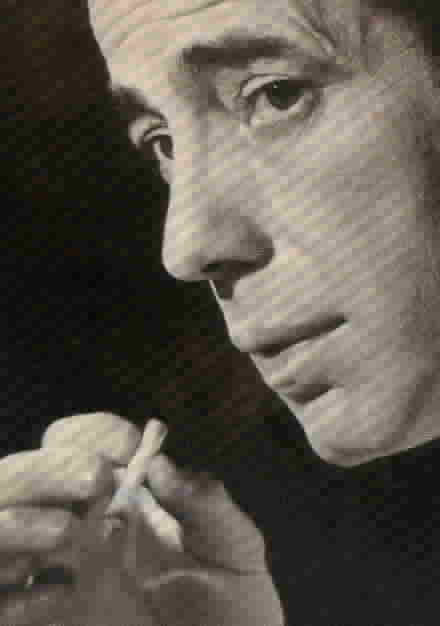
Detail of photo of Humphrey Bogart (copyright by the Ludlow Collection)