TOUCH CUE
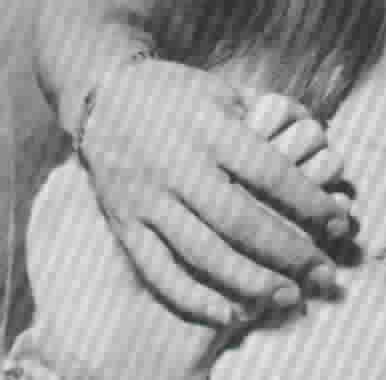
Most decide by "the touch," that is, the feel . . . . --Andrew Ure
Touch is infrequent and usually consists of a slight tap on a woman's shoulder. Or he may run his arm around the waist of a woman visitor. Men are never touched by [TV talk-show host, Phil] Donahue. --Walburga von Raffler-Engel (1984:16).
Tactile signal. 1. Incoming: A sign received through physical contact with a body part (e.g., a
hand or lip), causing it to feel (see HOMUNCULUS). 2. Outgoing: A sign of physical contact
(e.g., of pressure, temperature, or vibration) delivered to a body part (see, e.g., KISS).
Usage I: Touch cues are powerfully real to human beings. If "seeing is believing," touching is
knowing-- i.e., "knowing for sure." Touch cues are used worldwide to show emotion, e.g., in settings
of childcare, comforting, and courtship, and to establish personal rapport.
Usage II: Self-touching is often seen in anxious or tense settings, as a form of self-consolation by means of self-stimulation (see below, Usage IV).
Usage III: "Soft" or protopathic touch--which is found in hairless (or glabrous) areas of our skin--is partly responsible for itching, tickling, and sexual sensations (Diamond et al.1985:4-6). Protopathic touch is ancient, but gives little information about the size, shape, texture, or location of a tactile stimulus.
Usage IV: "Itch" sensations may trigger the spinal cord's rhythmic, oscillating scratch reflex. Scratching stimulates pain receptors (or nociceptors) which drown out (i.e., block) the itchy feeling. Primates often scratch themselves in anxious social settings and when intimidated by dominant rivals.
Usage V: "Tickle" is a tingling sensation, considered both pleasant and unpleasant, which often results in laughter, smiling, and involuntary twitching movements of the head, limbs, and torso.
Anatomy. The outer covering of skin is our body's largest "part." Skin makes up about 15% of the body's weight (ca. 23 lbs.), and occupies some 21 square feet of surface area (Wallace et al.1983:254). Pain and protopathic touch cues are received via free nerve endings in
the skin and hair follicles. More specialized nerve endings have evolved for finer touch and
temperature discrimination. Mechanoreceptors (including Pacinian corpuscles, Merkel's disks,
and Meissner's corpuscles) sense pressure, stretching, and indenting of the skin. Thermoreceptors (Krause
end bulbs for cold and organs of Ruffini for heat) are sensitive to changes in temperature.
Culture. 1. According Edward Hall (1966), "contact cultures" (e.g., France, Latin America, and Saudi Arabia) use a greater frequency of aroma and touch cues than do "noncontact cultures" (e.g., Germany and North America), which use more visual cues. 2. The buttock pat, used in American football as a sign of encouragement, has spread to European sports (Morris 1994:14). 3. In Germany, Austria, Eastern Europe, and the Middle East, the buttock slap--in which the right buttock pushes out as if or to be slapped with one's own right hand--is given as a sign of insult (Morris 1994:14).
Evolution. The most primitive, specialized tactile-sense organ in vertebrates is the neuromast, a
fluid-filled pit in the skin of today's fishes, which picks up vibrations, heat, electrical, and (perhaps)
chemical signals in the surrounding water. Each neuromast contains a hair cell, which, when
moved by water currents generated by a nearby fish, e.g., stimulates a sensory nerve. Through the
neuromast, the current becomes a nonverbal sign of another fish's presence.
Handshake. Grasping another's hand with a power grip is a widespread means of expressing congratulations, contractual agreement, farewell, and greeting. The handshake is European in origin (Morris 1994), although many cultures touch hands and other body parts with the hand(s) to greet family members and fellow tribesmen. These socio-emotional touch cues developed from tactile signs originally used in mammalian grooming and childcare. 1. "We do know that the full Hand Shake occurred as early as the 16th century because in Shakespeare's As You Like It there is the phrase: 'they shook hands and swore brothers'" (Morris 1994:125). 2. In the politician's handshake, two hands reach out to clasp and surround another's hand, like a glove, to intensify the emotions aroused by physical closeness and "friendship." According to Morris (1994:126), the glove handshake is widespread in "diplomatic, political and business circles." 3. A study reported in the July 2000 Journal of Personality and Social Psychology found that women ". . . who introduce themselves with an assertive gesture by way of a firm handshake were perceived as being intellectual and open to new experiences" (Lipsitz 2000:32).
Primates. "A troop of [at least 100] furious monkeys in India's northeastern state of Assam brought traffic to a standstill after a baby monkey was hit by a car on a busy street. . . . . The angry monkeys kept traffic at bay for more than a half hour as they tried to care for the infant. A local shopkeeper said: 'It was very emotional . . . some of them massaged its [broken] legs'" (Newman 2000:C14).
Space. When Apollo 11's pilot, Michael Collins, flew above the Moon, he felt he could "almost reach out and touch it" (Collins1988:5).
Sports. Many baseball players go through touch rituals before they come to bat. "Nomar Garciaparra, the shortstop for the Boston Red Sox, has a routine with his batting gloves [i.e., he compulsively adjusts and re-adjusts them] that would rival the machinations during the changing of the guard at Buckingham Palace" (Wilkens 1998:E-3).
RESEARCH REPORTS: In a review of studies of people touching one another, Vrugt and Kerkstra (1984) concluded that a. touching of opposite-sex acquaintances, "even at an early age," is avoided (p. 14); b. young adults, "as when bowling," touch each other more in mixed than in same-sex interactions (p. 14); c. "old" women touch more than "old" men, seemingly due to declining sexual interests (pp. 14-15); d. while greeting and departing, men "behave less intimately toward each other" than women behave toward each other (p. 15 [Author's note: But hugging has become more prevalent among U.S. men since the 1980s.]); and e. women "shrink less from being touched by strangers than men" (p. 15).
Neuro-notes: We find pleasure in a carpet's softness, as it stimulates the poorly localized tactile
sensations for soft or protopathic touch, carried by the anterior spinothalamic nerves (whose paleocircuits are
phylogenetically older than those for the more precise sensations of pain and temperature, carried by the lateral
spinothalamic nerves.
See also AROMA CUE, COLOR
CUE, EMOTION CUE, TASTE CUE.
Copyright 1998, 1999, 2000 (David B. Givens/Center for Nonverbal Studies)
Detail of photo (James Dean holds Julie Harris's hand; copyright by Warner Bros., Inc.)