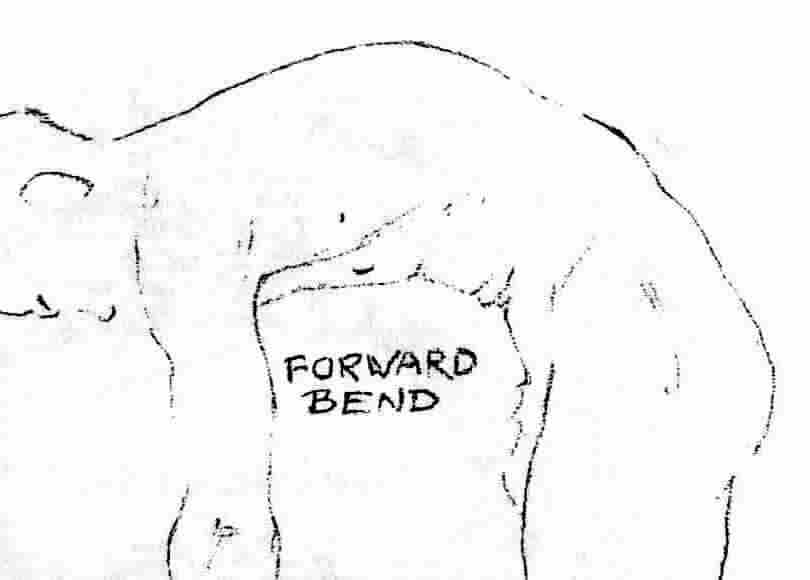
Posture. To contract muscles of the primitive body wall, causing the spinal column to tip forward, sideward, or backward from standard anatomical position.
BODY-BEND
Posture. To contract muscles of the primitive body wall, causing the spinal column to tip
forward, sideward, or backward from standard anatomical position.
Usage: As expressive cues, body-bend (i.e., axial-skeleton) postures are more fundamental as
mood signs than are leg and arm (i.e., appendicular) postures. Bending the spinal column away
from the person seated beside oneself at a conference table, e.g., is a reliable--and wholly
unconscious--sign of disagreement, disliking, or shyness. (See BODY SHIFT.)
Anatomy. Bending motions of the head and trunk are neurologically "simple" as signs.
Unaffected, unintended, and unconscious, they are among the most reliable indicators of mood.
Bowing, for instance--flexing the spinal column forward (ventrally)--is a protective response which
also shows submissiveness and lowered social status. (N.B.: Even without a formal tradition of
bowing [e.g., such as that of the Japanese] we may still tip our head and bend our spinal column
forward when entering a superior's office doorway. Rearing, on the other hand--extending the spine
backward [dorsally]--conveys arrogance and disdain [see HEAD-TILT-BACK].)
Culture. In southern Italy, the buttocks thrust--in which the stiffened (extended) upper body bends forward and the buttocks thrust backward, toward another person--is a sign of "obscene disdain" (Morris 1994:16). According to Morris, "This simple gesture is essentially an excretory insult, with the message 'I defecate on you'" (1994:16).
Evolution. Our body began as a simple tube, with a mouth at the front end to take in food, and a
vent at the rear to eliminate waste products. Among the oldest body movements were those for
locomotion. Muscles of the body wall contracted to produce rhythmic sideward bending
motions. These oscillatory swimming movements took animals toward food or mates, and away
from harm.
Neuro-notes. The first side-to-side oscillations were wired into paleocircuits of the aquatic brain & spinal cord. They appeared as alternating movements of the body's right and left sides. Extremely primitive, the same spinal circuits enable us to walk, swim, and dance today.
See also ANGULAR DISTANCE.
Copyright 1999, 2000 (David B. Givens/Center for Nonverbal Studies)
Detail of drawing (Peck 1951:32; copyright Oxford University Press)