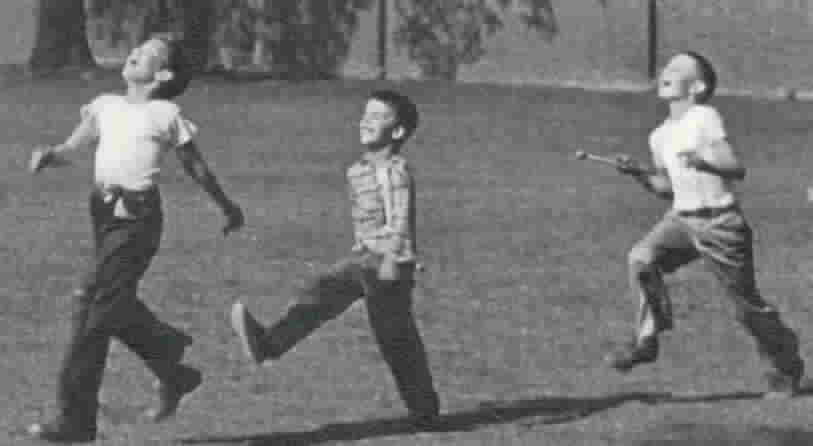
The body dances in time with the speech. --Condon and Ogston (1967:225)
DANCE
The body dances in time with the speech. --Condon and Ogston (1967:225)
The truest expression of a people is its dances and its music. Bodies never lie. --Agnes de Mille
Body motion. A repetitive series of usually rhythmic movements of the body and body parts
(esp. feet, hands, and shoulders) to a musical beat, based on the alternating oscillations of
walking.
Usage: An ancient and powerful medium of nonverbal communication, dance is a nearly universal venue of
human courtship. Dance not only synchronizes a couple's physical movements (e.g., as they move to the beat of the same drummer), but their
moods and feelings as well. Some dance forms (e.g., break dancing, military marching, and the tribal
war dance) stimulate strong feelings of togetherness and esprit de corps through the reptilian
principle of isopraxism.
Anthropology. "One field which still awaits exploration is the squestion [sic] of how far a dominant kinesthetic awareness of certain parts of the body is related to psychological factors. If posture and movement of an individual are closely interdependent with his psychological state, would not stylized posture and gesture in the dance of a people be relevant to a general psychological trend in their life?" (Holt and Bateson 1944:52; the authors contrast, e.g., "rhythmic, rotating movements of the pelvic region" with "rigid" postures of the torso and hips in dancing).
Motions. The human form is more noticeable when moved. Thus, dancers not only
attract attention of partners but of onlookers as well. Through (usually) palm-down
motions, the arms participate in dance as "walking forelimbs." Exaggerated reaching (i.e.,
extension) movements of the arms (e.g., while waving the hands high above the head) signal strong
emotions through the principle of nonverbal release (see, e.g., ATNR). In dancing, a. we show our
emotions and physical prowess (i.e., health), while b. giving our partners an opportunity to touch.
Popular culture. When Joey Dee and the Starlighters played loud music with a beat at the Peppermint Lounge in New York in the 1960s, "even the waitresses were twisting" (Sutton 1984:33).
Neuro-notes I. The oscillating movements and rhythmic footsteps of dance are keyed to a
two-point pedestrian beat. The natural rhythm of our upright, bipedal gait is coordinated by
the same spinal paleocircuits which programmed the oscillatory swimming motions of the early
fishes (Grillner 1996; see AQUATIC BRAIN & SPINAL CORD).
Neuro-notes II. In right-handed dancers, music appeals to the more emotional, intuitive, and nonverbal right-brain hemisphere. Thus, dancing couples are on simlar feeling (rather than thinking) wavelengths .
Copyright 1999, 2000 (David B. Givens/Center for Nonverbal Studies)
Detail of photo by Alfred Eisenstaedt (copyright Life)