CANDY
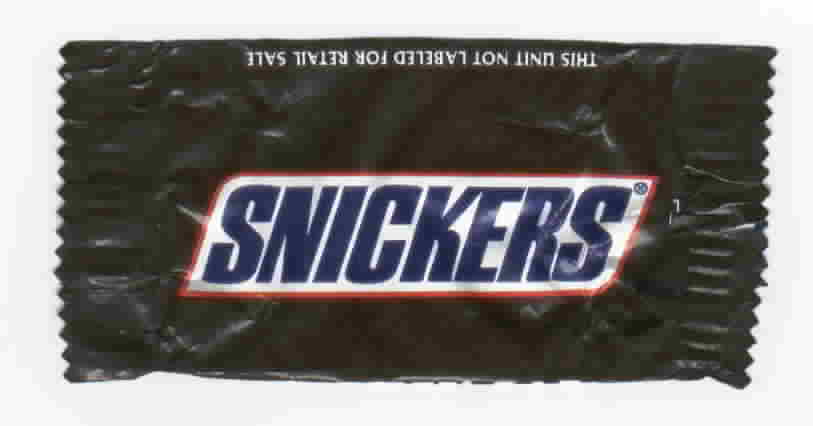
Fruit substitute. 1. A rich confection, such as a strawberry sucker or a chocolate mint, designed
to communicate with our taste buds for sweetness and, secondarily, with our receptors for sour,
bitter, or salty tastes. 2. A food product designed to mimic the usually sweet taste of ripe
fruit.
Usage: In U.S. supermarkets, the three best-selling candy bars--M&M's®, Snickers®, and Reese's
Peanut Butter Cup® (Krantz 1991)--contain nuts, and are crunchy rather than merely soft. The
top three successfully combine sweetness and nuttiness in a proven evolutionary formula for
primates. So tasty are these and other candy bars that, according to the Hershey company, two-thirds are eaten immediately upon purchase.
M&M's. Colorful, nut-sized M&M's® are among the most popular fruit substitutes of all time.
Their crisp, candy coatings encase milk chocolate mixed with finely ground peanut powder. On
average, U.S. citizens swallow 11,000 M&M's in a lifetime (Heyman 1992), liking the orange ones
least. (N.B.: The primate brain decodes orange as a warning (or aposematic)
coloration sign, often associated with poisonous snakes, insects, and berries.)
See also COCA-COLA®, EXISTENTIAL CRUNCH, NUT SUBSTITUTE.
Copyright 1999, 2000, 2001 (David B. Givens/Center for Nonverbal Studies)
Snickers wrapper (copyright 1999 by Mars, Inc.)