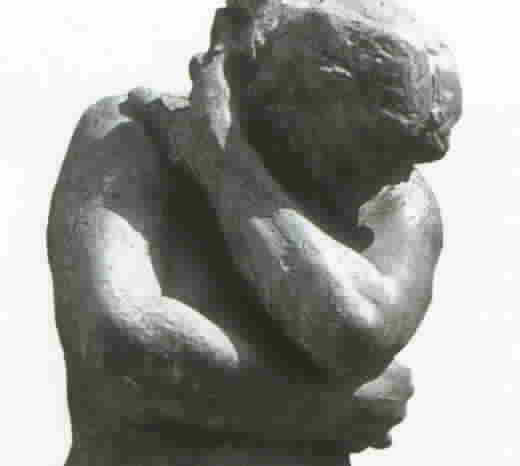
FLEXION WITHDRAWAL
Reflexive body movement. An automatic escape motion designed to remove a body part or parts from danger (e.g., flexing the neck to lower and protect the head).
Usage: Flexion withdrawal underlies many negative and submissive nonverbal signs (e.g., cues of disagreement, disliking, and fear; see BODY-BEND, BOW, CROUCH, GAZE-DOWN, HEAD-TILT-SIDE, and SHOULDER-SHRUG).
Business. Around a conference table, colleagues may reveal unvoiced negative feelings in postures influenced by flexion withdrawal, e.g., pulling the hands and arms backward, away from disliked speakers.
Biology. In mammals, the most primitive protective response is a flexion withdrawal, which "takes the head and neck away from the stimulus" (Salzen 1979:130).
Embryology. The crouch posture is "a protective pattern characteristic of the early embryonic flexion response" (Salzen 1979:136). By 8 weeks, e.g., the human fetus already "knows" to withdraw its head and neck when its mouth is touched. Defensive, coordinated flexing and withdrawing movements have been seen in immature fish larvae, in marine snails, and in human embryos at eight weeks of age. ln four-legged animals whose brains have been surgically disconnected from their spinal cords, almost any tactile stimulus will cause flexor muscles to contract and withdraw a limb from whatever touched it (Guyton 1996).
Anatomy. Human arms and legs have highly developed flexor reflexes. Automatic escape movements, coordinated by the spinal cord, can be triggered, e.g., by scalding pot handles--or by strong emotions from the amygdala.
Neuro-notes. Jumping to sound involves body-flexion movements configured in paleocircuits
of our amphibian brain. Through their nerve fibers, auditory-lobe impulses reach down to
excite spinal networks of interneurons and motor neuronsin charge of muscles that flex our
shoulders and arms, and bow our heads in the protective crouch posture.
See also NONVERBAL RELEASE.
Copyright 1999 (David B. Givens/Center for Nonverbal Studies)
Detail of Auguste Rodin's Eve (photo copyright Descharnes & Descharnes)