The Zebrafish
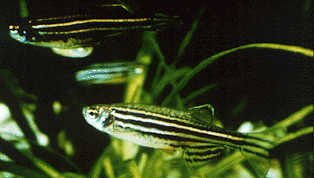
The zebrafish, Danio rerio, has become another popular "model" organism with which to study fundamental biological questions.
It is a small (1–1.5 inches) freshwater fish that grows easily in aquaria (it is available at many pet stores).
Some of its advantages for biologists:
- It breeds quickly and often (daily).
- It is a vertebrate, like us, and thus can provide clues to human biology that invertebrates like Drosophila and Caenorhabditis elegans may not.
- Its embryos, like those of most fishes, develop outside the body where they can be easily observed (unlike mice).
- Its embryos are transparent so defects in development can be seen easily.
- Individual cells in the embryo can be labeled with a fluorescent dye and their fate followed.
- Embryonic development is quick (they hatch in two days).
- They can absorb small molecules, such as mutagens, from the aquarium water.
- Individual cells — or clusters of cells — can be transplanted to other locations in the embryo (as Spemann and Mangold did with Xenopus — Link).
- They can be forced to develop by parthenogenesis to produce at will homozygous animals with either:
- a male-derived or
- female-derived genome.
- They can be cloned from somatic cells.
- They can be made transgenic (like mice and Drosophila)
- Its genome (1.8 x 10⁹ base pairs) is currently being sequenced.
"Forward" and "Reverse" Genetics
Forward
Since Mendel's time, most genetics has involved
- observing an interesting phenotype
- tracking down the gene responsible for it.
So this "forward" genetics proceeds from phenotype -> genotype.
Some examples in these pages:
These methods have been called "forward" genetics to distinguish them from a more recent approach, which has become an urgent priority with the successes of genome sequencing.
Reverse
Rapid methods of DNA sequencing has generated a vast amount of data.
Thousands of suspected genes have been revealed (e.g., finding open reading frames — ORFs), but the function of many of them is still completely unknown.
But now with
- a knowledge of the DNA sequence of a gene of unknown function,
- one can use methods for suppressing that particular gene ("knockdown"), and then
- observe the effect on the phenotype.
So this "reverse" genetics proceeds from genotype -> phenotype.
Reverse genetics has been applied successfully to
For example, the function of a mysterious gene sequence in Danio can be studied by
- synthesizing a short antisense olignucleotide complementary to a section of the gene.
- The oligonculeotide is chemically-modified to make it more stable than a fragment of RNA.
- Binding to its complementary sequence on the mRNA produced by transcription of the animal's gene, blocks ("knocks down") gene expression by
- preventing translation or
- disrupting normal splicing of the mRNA.
| Links to other examples of how this technology is used in reverse genetics.
|
Because we share so many similar gene sequences (orthologous genes) with Danio, if one can discover the function of the gene in Danio, then we have a better idea of the role of its ortholog in humans.
| The image above is courtesy of Sarah Farrington of the
Center for Cancer Research at MIT. It comes from the home page of ZFIN ("Zebrafish Information Network"): http://zfin.org/cgi-bin/webdriver?MIval=aa-ZDB_home.apg |
11 December 2004