NONVERBAL CONSCIOUSNESS
Author's invitation: Readers are cordially invited to contribute ideas on the topic of "nonverbal consciousness," CNS's initiative for calendar years 2000 through 2001. Please mail or e-mail your insights to David B. Givens or Susan E. Wong at the Center for Nonverbal Studies (address below). Results will be published on this page, and a final report will be presented at the November 2001 Annual Meeting of the American Anthropological Association.
[Updated 05-06-2001. What's new?]
For the first time in four billion years a living creature had contemplated himself and heard with a sudden, unaccountable loneliness, the whisper of the wind in the night reeds. Perhaps he knew, there in the grass by the chill waters, that he had before him an immense journey. --Loren Eiseley, The Immense Journey (1957)
Concept. The state or condition of being aware--apart from the effects or influence of words--of
one's own existence, environment, and sensations, i.e., of one's own self and place in Nonverbal World.
Usage: Approaching human consciousness from a novel perspective--i.e., from that of the
nonverbal brain--promises to shed new light on the perennial, philosophic issue of mind. Our species's bias for speech has to date obscured the preverbal origins and underpinnings of consciousness.
Significance. Ironically, the feeling that something is real, true, and right comes not from the thoughtful speech areas and association modules of our neocortex, but from evolutionary older--and nonverbal--emotion centers of our limbic cortex (see MacLean 1990:17).
Word origin. The word conscious comes from Latin com-, com- + scire, to know.
Japanese tea ceremony. Many cultures have devised ways for their members to periodically break the bonds of linguistic consciousness, distraction, and thought. The Japanese tea house, e.g., is designed as a nonverbal consumer product whose theme is an approximation of Nonverbal World: "Tea houses were a place for [wordless] concentration. The garden was and is not in view so the inhabitants will not be distracted. Guests go from a waiting lodge to a waiting bench both in the outer tea garden. This is where the host meets them. In the meantime they are able to absorb the beauty of the garden and prepare themselves spiritually for the tea ceremony" (Anonymous, N.D.:4).
Language. 1. "The use of the term 'forced observation' must not be construed to imply that a speaker of a language is conscious of being compelled to notice certain aspects of his environment. Most often he makes these observations naturally, almost unconsciously, and certainly with no feeling of constraint" (Henle 1958:383). 2. "In the case of the left [brain] hemisphere, consciousness is linked with language
capacity" (Restak1994:127). 2. "Of all the characteristics that differentiate humans from their nonhuman cousins, the ability to communicate through the use of a sophisticated spoken language is, I believe, the most significant" (Goodall 1990:208).
Levels of consciousness. The five levels of consciousness used in the standard neurologic examination include a. alert, b. lethargic (drowsy), c. obtunded (asleep), d. stupor (semicoma, can be aroused but returns to unconsciousness without strong stimulation), and e. coma (deep coma, cannot be aroused; Nolan 1996:24).
Media. "Kick a dog and you can be pretty sure that the next time it sees you it will associate you with being kicked," said [Gerald] Edelman [Neurosciences Institute, La Jolla]. "As a result, it may run away or bite you. It will not, however, sit there quietly and plot how to destroy your tenure as a professor." The latter ability, Edelman thinks, belongs only to human beings, and is due to a "higher-order consciousness." (San Diego Union-Tribune, Jan. 29, 1999, E-5)
Mind-body. "As to the mind-body problem, [Roger] Sperry defines consciousness as 'a holistic or emergent, functional property of high-order brain activity.' And that's about as elegant a definition as one can hope for" (Falk 1992:109). {Editorial comment: But where's the beef?}
Neanderthals. "We found that the two communities [Neanderthal and early Homo sapiens sapiens] were supported by different capacities for communication--verbal, visual and symbolic--and that this in turn affected their organization of campsites, their exploitation of the landscape, and their colonization of new habitats" (Stringer and Gamble 1993:219).
Neurobiology. There is no working definition of consciousness--or more accurately, there are hundreds of working definitions. --Terrence J. Sejnowski (Computational Neurobiology Lab, Salk Institute)
Neuropsychology. But having reached that [higher level of] understanding [of the biology of consciousness], which we have not, I don't know if it will tell us much about the magic of consciousness, how and why we get something like self-awareness {happiness} out of matter. --Larry Squires (University of California, La Jolla)
Neuroscience I (prefrontal cortex). Further, damage to our frontal areas can reduce any of us to an almost subhuman level of functioning, a kind of psychic limbo where we dwell in an eternal present, devoid of what I consider our most evolved mental ability: our capacity to empathize with {care for} others. --Richard Restak
Neuroscience II (split-brain experiments). 1. "Our consciousness may be a single stream because it is the consciousness of our dominant hemisphere only" (Carter 1998:51). 2. "Or it could be that there are many streams of consciousness in each of us . . ." (Carter 1998:53).
Paralysis. "I gradually learned to live day by day, to block from my consciousness any thoughts about the final outcome of the illness, to repress from awareness any vision of the unthinkable" (Murphy 1987:25).
Philosophy I. Suppose that there be a machine, the structure of which produces thinking, feeling, and perceiving; imagine this machine enlarged but preserving the same portions, so that you could enter it as if it were a mill. This being supposed, you might visit it inside; but what would you observe there? Nothing but parts which push and move each other, and never anything that could explain perception. --Leibniz
Philosophy II. Consciouness: "A term with two related philosophical uses: first, as for example, for Locke, in the sense of self-knowledge acquired by virtue of the mind's capacity to reflect upon itself in introspective acts analogous with perception; and second, in a broader modern sense, opposed to anaesthesia, designating what is held to be the general property of mental states" (Flew 1979:72-73). Would the pleasant "full" feeling after a meal count as an introspective act? (See, e.g., ENTERIC BRAIN, REST-AND-DIGEST.)
Philosophy III. Consciousness is the ultimate mystery, a mystery that human intelligence will never unravel. --Colin Tudge (Prof. of Philosophy, Rutgers)
Philosophy IV. "We laugh, therefore we are." (CNS staffers)
Physics. "At the atomic level, 'objects' can be understood only in terms of the interaction between the processes of preparation and measurement. The end of this chain of processes lies always in the consciousness of the human observer" (Capra 1977:126).
Primatology. 1. "Having opened a window onto nonhuman consciousness, we discover a mental landscape resembling our own. We find that other primates, at least, are capable of elementary logic, jokes, banter, deliberate misinformation, cajoling, deep sorrow, [and] rich communication" (Hooper and Teresi 1986:54). 2. ". . . it was proved, experimentally and beyond a doubt, that chimpanzees could recognize themselves in mirrors--that they had, therefore, some kind of self-concept" (Goodall 1990:21). 3. "Some chimpanzees love to draw, and especially to paint" (Goodall 1990:22).
Right brain, left brain. Studies agree that as nonverbal cues are sent and received, they are more strongly influenced by modules of the right-side neocortex (esp. in right-handed individuals) than they are by left-sided modules. Anatomically, this is reflected a. in the greater volume of white matter (i.e., of myelinated axons which link nerve-cell bodies) in the right neocortical hemisphere, and b. in the greater volume of gray matter (i.e., of nerve cell bodies or neurons) in the left. The right brain's superior fiber linkages enable its neurons to better communicate with feelings, memories, and senses, thus giving this side its deeper-reaching holistic, nonverbal, and "big picture" skills. The left brain's superior neuronal volume, meanwhile, allows for better communication among the neocortical neurons themselves, which gives this side a greater analytic and intellectually narrower "focus" (see, e.g., Gur et al. 1980).
Robotics. A third generation of robots ". . . will learn very quickly from mental rehearsals in simulations that model physical, cultural and psychological factors. Physical properties include shape, weight, strength, texture and appearance of things, and how to handle them. . . . . The simulation would track external events and tune its models to keep them faithful to reality. It would let a robot learn a skill by imitation and afford a kind of consciousness" (Moravec 1999:135).
Sleep. For early 20th-century psychologist, William James, consciousness is what we lose when we fall into a deep, dreamless sleep.
Space. "A section of the [London taxi] cabbies' brains, called the hippocampus, became enlarged during the two years they spent learning their way around the vast, complicated metropolis" (Boyd 2000; see PRIMATE BRAIN, Climbing cues).
Synonyms. Nonverbally "known, supraliminal; aware, appreciative, cognizant (KNOWLEDGE); sensible, aesthetic or esthetic, passible (SENSITIVENESS); calculated, studied, premeditated (PURPOSE)" (Lewis 1978).
Time. "Mental chronometry can be defined as the study of the time course of information processing in the human nervous system" (Posner 1978:7).
Vision. "It can be postulated that in evolution the emergence of conscious mental experiences matched the evolution of the visual processing mechanism (see, e.g., FACIAL RECOGNITION, Neuroanatomy I & II), and that it was essential in guiding the behaviour of the animal" (Eccles 1989:175).
Zen. "So long as we merely talk about it, so long as we turn over ideas in our minds about 'symbol' and 'reality,' or keep repeating, 'I am not my idea of myself,' this is still mere abstraction. Zen created the method (upaya) of 'direct pointing' in order to escape from this viscious circle, in order to thrust the real immediately to our notice {eyes}" (Watts 1957:126-27).
RESEARCH RESULTS: 1. "Consciousness resists definition partly because it is so familiar"
Restak1994:123). 2. "But the right [brain] hemisphere's abilities (the intuitive apprehension of
geometrical properties, copying designs, recognizing faces, and reading facial expressions)
clearly imply that some degree of consciousness, albeit a nonverbal one, must exist [alongside
the left hemisphere's linguistic consciousness (see above, Language)]" (Restak1994:127).
Neuro-notes I. It is within the thalamus that a human's central nervous system first experiences a consciousness of incoming sensations, before they are re-examined, upstream, in the neocortex [HB:5-17].
Neuro-notes II. As conscious creatures, we "can and do react with fear even though consciously
we haven't the slightest idea what it is that is frightening us. Heightened 'startle responses,'
sudden onsets of anxiety or even panic, personality characteristics like being 'hyper' or
'edgy'-these are everyday examples" (Restak1994:147).
Neuro-notes III. "Objective brain processes knit the subjectivity of the conscious mind out of the cloth of sensory mapping [e.g., of a seen object on the visual cortex]. And because the most fundamental sensory mapping pertains to body states and is imaged as feelings [the mammalian cingulate cortex is key for Damasio], the sense of self in the act of knowing emerges as a special kind of feeling--the feeling of what happens to an organism caught in the act of interacting with an object" (Damasio 1999:117).
See also NONVERBAL LEARNING, PAPERS ON CONSCIOUSNESS.
Copyright© 1998 - 2001 (David B. Givens/Center for Nonverbal Studies)
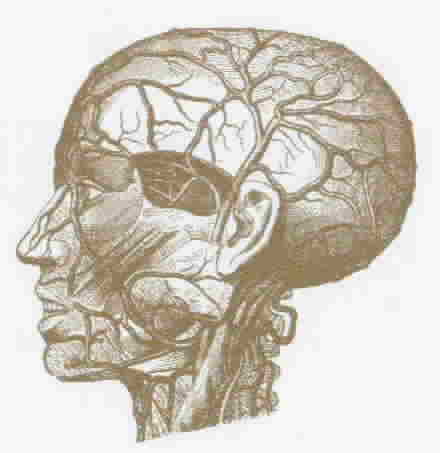
Drawing of a head (copyright 1996 by Clare Gibson and Saraband Inc.)
His Holiness Pope John Paul II (copyright Prospect Hill Co.)